What You Need to Know
- A bar that is always ready: Five things must be in place before the first guest arrives foundation spirits for the cocktails you actually make, fresh mixers opened to order, measured tools within arm's reach, chilled glassware, and garnishes that require no last-minute preparation.
- Foundation spirits that cover the most ground: Bourbon or rye, gin, tequila, and vodka cover the majority of classic cocktails. Angostura bitters and sweet vermouth are the two most useful modifiers beyond base spirits both are required for Old Fashioneds, Manhattans, and Negronis.
- Ice quality affects drink quality: Large ice spheres or cubes (silicone mold, under $15) have a lower surface-area-to-volume ratio than standard freezer cubes slower melting, better dilution control, and a significantly better visual result in a rocks glass.
- Dehydrated citrus solves the fresh garnish problem: A pouch in the cupboard with a 12-month shelf life means the garnish is always there no pre-service prep, no browning risk, no timing pressure regardless of when guests arrive.
- Glassware in a freezer for 15 minutes: The single highest-impact low-effort upgrade for home cocktail presentation. A frosted coupe or rocks glass signals preparation to the guest before the drink is tasted.
The difference between a home bar that is ready and one that is not comes down to one thing: preparation that happened before the guests arrived.
The host who always seems to effortlessly produce a perfect cocktail did not do it effortlessly. They did it on Tuesday, when they stocked the bar and made sure everything they needed was in its place. By the time the doorbell rang on Saturday evening, the only thing left to do was pour.
This is the mise en place principle applied to the home bar. Everything in its place before it is needed. Here is how to build a bar station that lives by it.
Step One: The Foundation Spirits
A well-stocked home bar does not need to cover every category. It needs to cover the categories you actually drink. Start there.
The four spirits that cover the most cocktail ground are bourbon or rye whiskey, gin, tequila, and vodka. If you drink primarily one or two of these, start with those and expand from there. The goal is a bar that produces excellent cocktails in the categories you love, not one that looks comprehensive but produces mediocre results because the bottles were chosen for coverage rather than quality.
Beyond the four base spirits, three supporting bottles cover the majority of classic cocktail requirements: Angostura bitters (required for Old Fashioneds, Manhattans, and Champagne cocktails), a dry vermouth for Martinis, and a sweet vermouth for Negronis and Manhattans. Vermouth is a wine-based product — it should be refrigerated after opening and used within four to six weeks.
Step Two: The Mixers
Freshness matters more in mixers than most people expect. Club soda or sparkling water should be bought in small bottles opened to order, not a large bottle that has been sitting half-flat in the fridge. Tonic water is the same small bottles, fresh open.
Ice deserves its own category. Small freezer ice melts faster and dilutes drinks quickly because of its high surface-area-to-volume ratio. A single large ice sphere or cube (made using a silicone mold, available for under $15) has less surface area relative to its volume and melts more slowly, producing better dilution control. For shaken drinks served up — Daiquiris, Gimlets, Whiskey Sours — the ice used in the shaker matters more than the ice in the glass, because shaking requires vigorous contact between ice and liquid.
Simple syrup can be made in five minutes (equal parts sugar and water, heated until combined, cooled) or bought pre-made. Keep a bottle in the fridge. Agave syrup is worth having separately if you make tequila cocktails regularly; it behaves differently from sugar syrup and suits the spirit better.
Fresh citrus juice is the one mixer that requires planning. Lemon and lime juice begin losing their brightness within hours of squeezing. For a home bar that is always ready, this is a genuine problem; you cannot squeeze lemons on Tuesday for cocktails on Saturday.
|
Fresh juice degrades within hours. The home bar that is always ready needs a solution to the fresh citrus problem. Dehydrated citrus is half of it. |
Step Three: The Garnishes — Where Most Home Bars Fall Short
For a home bar that is always ready, the garnish station requires three things: a dehydrated citrus selection covering the primary cocktail categories (orange, lemon, lime), a small plate or ramekin to arrange them in before guests arrive, and a dedicated position on the bar surface within reach of the pouring area. Set the garnish tray first — it takes sixty seconds — and everything afterward is just pouring.
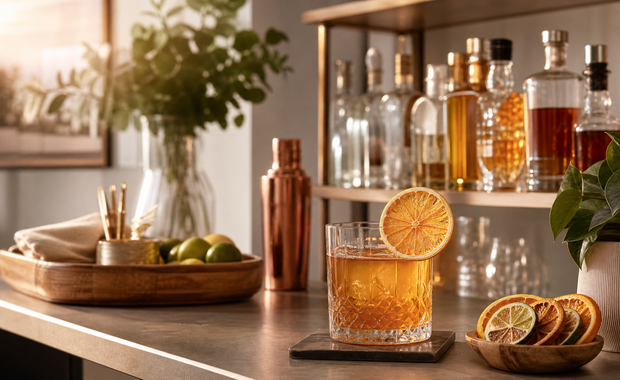
The gap between a home cocktail that looks impressive and one that looks like a drink someone made at home is usually the garnish. A great Old Fashioned with no garnish is still an Old Fashioned. An Old Fashioned with a slow-dehydrated orange slice on the rim is a completely different visual and aromatic experience.
The challenge with fresh citrus garnishes is that they require the same preparation planning as fresh juice. You cannot cut lemon wheels on Tuesday for Saturday. They brown, they dry out, and they lose their visual appeal within hours.
Citrus House dehydrated and dried citrus garnishes solve this entirely. A pouch of dehydrated orange slices in the cupboard means you always have a garnish for an Old Fashioned, regardless of when the guests arrive. The same pouch works for a Negroni, a Whiskey Sour if you prefer orange, or any tequila cocktail where you want a citrus note on the rim. The 12-month shelf life means you buy it once and it is there whenever you need it.
A well-stocked home bar should have dehydrated orange, lemon, and lime slices as standard. Grapefruit if you make Palomas. The Citrus House Variety Pack covers all four for $16 and takes one minute to stock.
Shop dehydrated and dried citrus garnishes
See garnish pairings for every cocktail
Step Four: The Tools
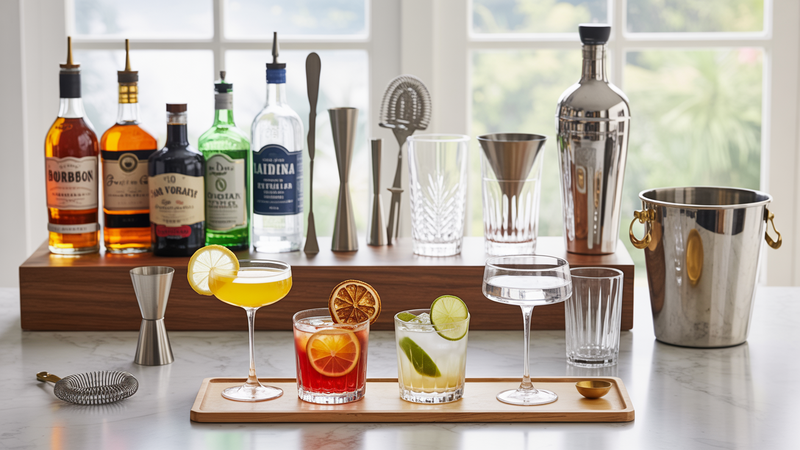
Tools used at every service—shaker, jigger, and strainer—live on the bar surface. Tools used occasionally—muddler, Y-peeler, channel knife for twists—live in a drawer or container beside the bar. The arrangement is not aesthetic: it is functional. Reaching past what you need while making a drink is the friction that makes hosting feel complicated rather than easy.
You do not need many. The tools that actually get used in a home bar are a cocktail shaker, a jigger for measuring, a bar spoon for stirred drinks, a strainer, and a Y-shaped vegetable peeler for citrus twists if you make them. A muddler if you make Mojitos or Old Fashioneds with muddled fruit.
Beyond this list, additional tools are nice to have but not the limiting factor in cocktail quality. A good shaker and accurate measuring will improve your drinks more than any specialist tool.
Step Five: The Glassware
Three glass types cover the majority of cocktails: a rocks glass for spirit-forward drinks served over ice, a coupe for shaken cocktails served up, and a highball for long drinks. A flute if you make champagne cocktails or French 75s.
Keep them clean, dry, and chilled. A glass that has been in the freezer for five minutes makes a better cocktail than a glass taken straight from the cupboard. This one habit, which takes zero effort, makes a visible difference.
The Bar That Is Always Ready
A home bar station that is always ready is not one that has everything. It is one that has the right things, in the right place, with nothing missing when you need it. The spirits are chosen deliberately. The mixers are bought fresh before each use. The garnishes never run out because they have a 12-month shelf life and zero prep requirement. The tools are simple, clean, and within reach.
When the doorbell rings, you are not scrambling. You are pouring.
|
The best home bar is not the most stocked one. It is the one that is always ready. |
|
Stock your home bar with dehydrated and dried citrus garnishes that are ready whenever you are. Citrus House garnishes have a 12+ month shelf life, zero prep, and are from $16. Shop at citrushousecraft.com. |