What You Need to Know
- The shelf life difference is explained by water activity (Aw): Fresh citrus has an Aw of ~0.97. Citrus House dehydrated garnishes are dried below Aw 0.60, the threshold at which no microbial or enzymatic spoilage can occur. That gap is the reason for 12 months versus 2 weeks.
- Fresh citrus browns through enzymatic oxidation: Polyphenol oxidase in the citrus flesh reacts with oxygen to produce brown melanin pigments within 30–60 minutes of cutting. Dehydration removes the free water this enzyme requires, permanently halting the reaction.
- Aroma compounds are concentrated, not destroyed: Limonene, linalool, citral, and myrcene are preserved by low-temperature drying and released progressively throughout the drink. In a fresh garnish, the same compounds dissipate within minutes of cutting.
- Yield compounds the cost difference: Fresh citrus produces approximately 85–90% usable garnish after prep loss. Every slice in a Citrus House pouch is usable: 100% yield, no prep loss, and no end-of-service discard.
- Preparation difference across a year: Fresh citrus requires weekly purchasing and pre-service prep at every gathering. Dehydrated citrus requires opening a pouch at any time, for the next twelve months, with no planning required.
Fresh citrus has a Monday problem.
You buy limes on Saturday for the margaritas you are making that evening. You use four. The remaining ten are in the fridge on Monday, and by Thursday two of them have gone soft. By the following weekend you are throwing away fruit you paid for, buying more, and starting the cycle again.
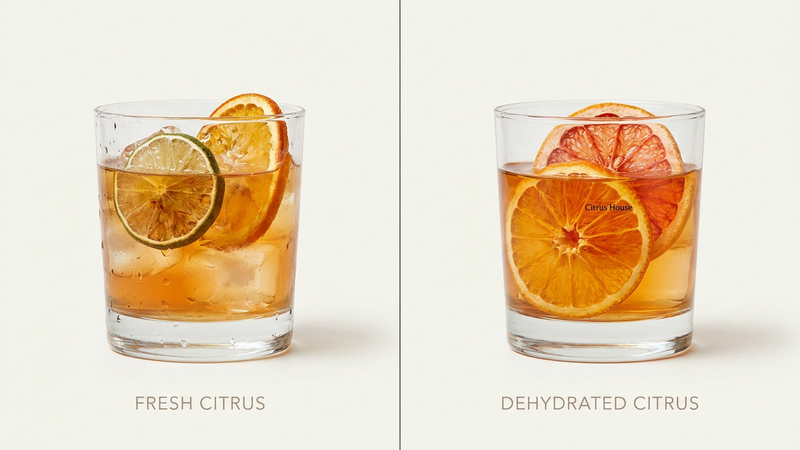
Dehydrated and dried citrus garnishes solve this problem entirely. But that is only one of the reasons they outperform fresh citrus in every measurable way that matters to someone who cares about how their cocktails look and taste.
Here is the full comparison.
Shelf Life
The underlying reason for the difference is water activity — the measurement of free water available for microbial and enzymatic activity. Fresh citrus has a water activity of approximately 0.97 (near the maximum of 1.0). Citrus House dehydrated garnishes are dried to a water activity below 0.60, the threshold below which spoilage cannot proceed.
Fresh citrus: 1–2 weeks
A cut lemon left at room temperature is already browning within an hour. Uncut citrus in the fridge gives you one to two weeks before quality begins to decline. Halved or sliced citrus prepared in advance deteriorates faster. For a busy bar or a household that does not make cocktails daily, fresh citrus is a perpetual waste problem.
Dehydrated citrus: 12+ months
A Citrus House dehydrated citrus slice in a sealed pouch has a 12-month shelf life without refrigeration. Open the pouch on day one or month twelve, and the garnish is identical. The color is the same. The aroma is the same. The structure is the same. There is no spoilage, no browning, no waste.
|
12 months versus 2 weeks. That gap represents hundreds of dollars of thrown-away citrus for a regular home entertainer. |
Fresh citrus: inconsistent and time-limited
A fresh citrus wheel cut ahead of service browns within 30 to 60 minutes of air exposure. The oxidation that gives a cut apple its brown edge does the same thing to a fresh citrus slice, and no amount of care prevents it.
A garnish that looked perfect when the drink was made looks noticeably different by the time the guest picks up the glass.
The browning of a cut fresh citrus surface is caused by enzymatic oxidation—polyphenol oxidase in the citrus flesh reacts with oxygen and phenolic compounds to produce the brown melanin pigments visible within 30 to 60 minutes of cutting. Dehydration removes the free water that this enzyme requires to function, halting the reaction permanently.
Fresh citrus also varies in size, color, and appearance from piece to piece and from week to week depending on seasonal availability and supplier.
Dehydrated citrus: consistent and permanent
A slow-dehydrated citrus wheel from a Citrus House pouch looks exactly the same at the end of a four-hour dinner party as it did at the beginning. The color does not change. The shape does not change. It does not brown, wilt, or lose its structure.
Every slice in the pouch is also visually consistent—same color, same thickness, same appearance—because the selection process ensures that only fruit at peak ripeness is dried, and the drying process locks in that quality.
Aroma
The specific compounds preserved by low-temperature dehydration include limonene (dominant in lemon and lime rind), linalool and citral (present in orange and grapefruit), and myrcene (contributing to grapefruit's distinctive bittersweet profile). At high temperatures, these monoterpenes volatilize before moisture removal is complete. At low temperature, moisture is removed slowly enough that the compounds concentrate rather than evaporate.
Fresh citrus: immediate and brief
The aroma of a fresh citrus garnish is strongest in the first few minutes after cutting. As the essential oils in the rind begin to dissipate, the aroma fades. By the end of the drink, the garnish contributes very little to the aromatic experience.
Dehydrated citrus: concentrated and progressive
The slow, low-temperature drying process that Citrus House uses to make dehydrated and dried citrus garnishes concentrates the essential oils rather than cooking them out. When the slice is placed in or on a drink, those oils are released slowly and progressively as the drink is consumed.
This is why every person who opens a Citrus House pouch for the first time comments on the aroma; it still smells like fresh citrus because the essential oils that make fresh citrus smell the way it does have been preserved rather than destroyed. And in the glass, that means the drink smells of citrus for its entire life rather than just its first few minutes.
Cost
The yield comparison compounds the cost difference: fresh citrus produces 85 to 90% usable garnish yield after prep loss (end pieces, damaged cuts, substandard fruit). Every slice in a Citrus House pouch is usable. The 100% yield on dehydrated citrus versus the 85 to 90% yield on fresh means the true per-garnish cost gap is larger than the invoice prices suggest.
Fresh citrus: cheaper per piece, expensive per use
Fresh citrus appears cheaper at first. A lime costs less than a fraction of a Citrus House pouch. But the calculation changes entirely when you factor in wastage. The limes you bought and did not use. The lemons that went soft before you needed them. The fruit that looked perfect in the shop was past its best by the weekend.
For a household that makes cocktails two or three times a week, the wastage cost of fresh citrus over twelve months is significant. The calculation gets worse for a bar that preps garnishes every day.
Dehydrated citrus: higher per pouch, zero waste
A Citrus House pouch costs $16 and contains 20 to 25 slices. Every slice gets used. The 12-month shelf life means there is no pressure to use the pouch quickly, no spoilage, and no waste. The cost per garnish used is competitive with fresh citrus when wastage is factored in and dramatically better when the shelf life advantage removes the weekly replacement cycle.
|
The question is not what a lime costs. The question is what you spend on items that you never actually use. |
Preparation
Fresh citrus: weekly prep required
Fresh citrus requires purchasing, washing, and slicing before every service. For a bar, that means prep time at the start of every shift. For a home entertainer, it means a trip to the shops before every gathering.
Dehydrated citrus: zero prep
Open the pouch. Place the slice on the rim. Done. The Citrus House garnish is ready the moment you need it, without any preparation, at any time of day or night, whether your guests gave you one week’s notice or one hour’s.
|
Shop dehydrated and dried citrus garnishes at citrushousecraft.com: 12+ month shelf life, zero prep, and zero waste. From $16 per pouch, 20–25 slices. |