
What You Need to Know
- The produce invoice is less than 70% of the true cost: The full cost of a fresh citrus program includes the produce invoice, prep labor (20–45 min/shift at $15–$18/hr), and spoilage/waste (15–25% of purchased fruit). The latter two costs are absorbed into other line items and rarely tracked directly.
- True annual cost for a mid-volume bar: For a bar doing 150–250 covers/night, 6–7 nights/week, the combined produce, labor, and spoilage cost runs approximately $11,000–$24,000 annually. The produce invoice alone represents $7,800–$15,600 of that total.
- Prep labor includes HACCP-mandated steps: washing, inspection, slicing, refrigerating, and date-labeling under food safety guidelines cannot be shortened. The labor cost is structural; it does not flex with revenue.
- Fresh citrus prices are subject to supply disruption: Mexico supplies ~95% of US lime imports. Weather-driven supply disruptions have doubled lime prices within weeks on multiple occasions in recent years, compounding the spoilage cost on higher-priced fruit.
- Dehydrated citrus wholesale cost at equivalent volume: Approximately $1,250–$1,650 annually for the same service volume at $8/unit with zero prep labor and zero spoilage. The year-one savings are immediate.
For the purposes of this analysis, a mid-volume bar is defined as 150–250 covers per night, operating six to seven nights per week, with a cocktail menu that includes citrus garnishes on 40 to 60% of drinks served.
Ask most bar managers what fresh citrus costs them, and they will give you the invoice total from their produce supplier. That number is wrong. Not because the invoice is incorrect, but because the invoice only captures one of the three costs of fresh citrus in bar service.
The full cost is the invoice, plus the labor to prepare it, plus the value of the fruit that never makes it into a drink.
When you add those three together, the number changes significantly.
Cost One: The Produce Invoice
The most visible cost and the one that appears on the P&L. For a mid-volume bar doing 200 covers on a busy night and offering citrus-forward cocktails, fresh citrus spend typically runs to $150–$300 per week, depending on the menu and volume. High-volume venues with extensive fresh juice programs spend considerably more.
This is the number that gets reviewed. It rarely gets questioned beyond the invoice level because it is visible and categorized. The other two costs are invisible.
Cost Two: Labour
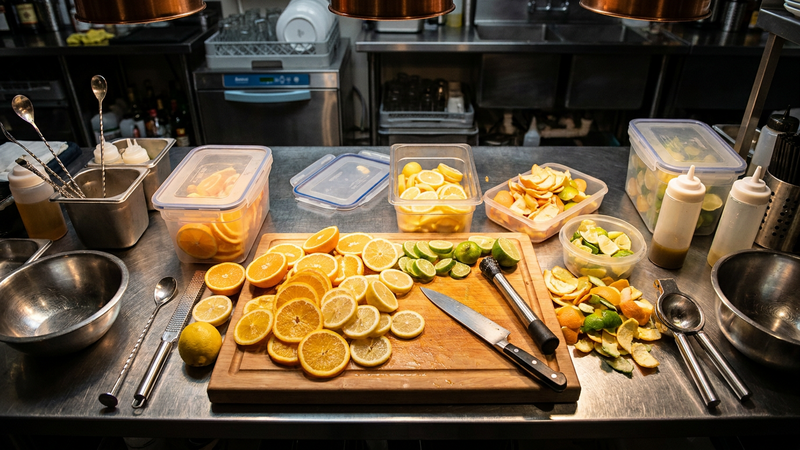
Fresh citrus does not slice itself. In a bar with a serious citrus program, garnish prep happens at the start of every shift. A bar back or junior bartender spends 20 to 45 minutes washing, slicing, and organizing garnishes before the first guest arrives.
The prep tasks that generate this labour cost are specific: washing fruit under running water (food safety requirement), hand-drying, visual inspection for damage, slicing to consistent thickness, arranging on the garnish tray, covering and refrigerating, and labeling with date and discard time per HACCP guidelines. A bar operating under health inspection standards cannot skip these steps.
At an average back-of-house labor rate of $15 to $18 per hour, that is $5 to $14 of labor cost per shift, per day, seven days a week. Across a year, that is $1,825 to $5,110 in labor costs that do not appear on any citrus line item.
It is paid. It is not tracked. And it is entirely avoidable.
|
The prep happens every shift whether or not the bar is busy. Labor cost does not flex with revenue. The waste does. |
Cost Three: Spoilage and Waste
This is the number that surprises most operators when they actually calculate it.
The spoilage cost is also compounded by seasonal price volatility. Lime prices in particular are subject to significant fluctuation driven by weather events in primary producing regions (Mexico accounts for approximately 95% of U.S. lime imports). During periods of supply disruption—which have occurred repeatedly in the past five years—lime prices have doubled within weeks. The spoilage cost on higher-priced fresh citrus is proportionally higher.
Fresh citrus has a usable window of 24 to 72 hours once cut. Uncut citrus in the walk-in has a longer life, but any bar operating with quality standards is cutting garnishes fresh each shift. At the end of service, unused cut garnishes are discarded. During service, pieces that were cut but not used, fruit that was damaged or miscut, and portions that went into prep waste all represent product paid for but not sold.
Conservative spoilage estimates for a mid-volume bar run to 15–25% of total citrus purchased. On a $200 weekly citrus spend, that is $30 to $50 per week in product that was ordered, delivered, stored, and never made it into a drink.
Across a year: $1,560 to $2,600 in citrus purchased and discarded.
The Full Number
|
Cost category |
Weekly estimate |
Annual estimate |
|---|---|---|
|
Produce invoice |
$150–$300 |
$7,800–$15,600 |
|
Labour (prep only) |
$35–$98 |
$1,825–$5,110 |
|
Spoilage / waste (20%) |
$30–$60 |
$1,560–$3,120 |
|
Total true cost |
$215–$458 |
$11,185–$23,830 |
These are mid-volume estimates. High-volume venues spend proportionally more. The point is not the specific number; it is that the number on the produce invoice represents less than 70% of the true cost of a fresh citrus program.
What Dehydrated Citrus Changes
Citrus House dehydrated and dried citrus garnishes wholesale at $8 per unit. Each pouch contains 20 to 25 garnish slices with a 12-month shelf life and zero prep requirement.
For a bar currently spending $15,000 annually on the full fresh citrus cost (using the mid-range estimates in the table above), switching to a dehydrated citrus wholesale account at $24–$32 per week results in an annual garnish cost of approximately $1,250–$1,650. The year-one savings—without accounting for labor recaptured for other tasks—represent a payback period of zero: the first week of the switch pays for itself.
Zero prep eliminates the labor cost entirely. The 12-month shelf life eliminates spoilage. The garnish is consistent from the first slice to the last. No staff time. No waste. No Monday morning produce delivery anxiety.
A bar doing 200 covers a night and placing a dehydrated garnish on every citrus cocktail, say 60 to 80 cocktails per service, uses approximately three to four pouches per week at wholesale pricing. That is $24 to $32 per week in garnish cost, with no labor and no wastage to add.
The comparison to the table above does not require further explanation.
|
200+ bars have already made the switch. Wholesale pricing from $8 per unit. Apply for a Citrus House wholesale account at citrushousecraft.com/pages/wholesale. |